Monday, January 5, 2015
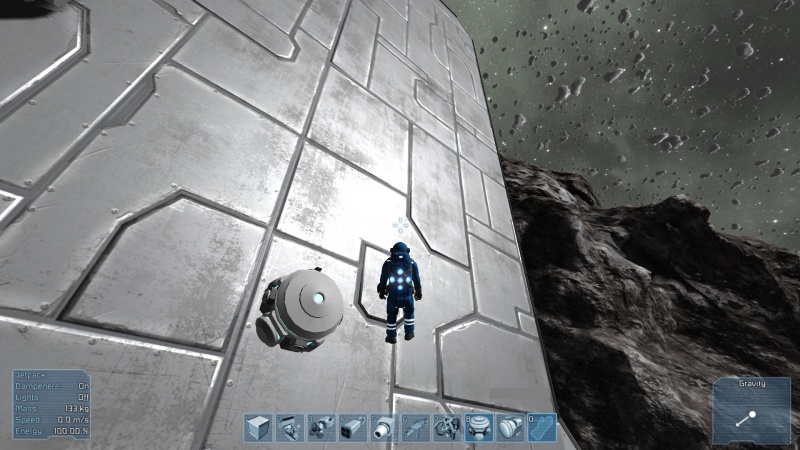
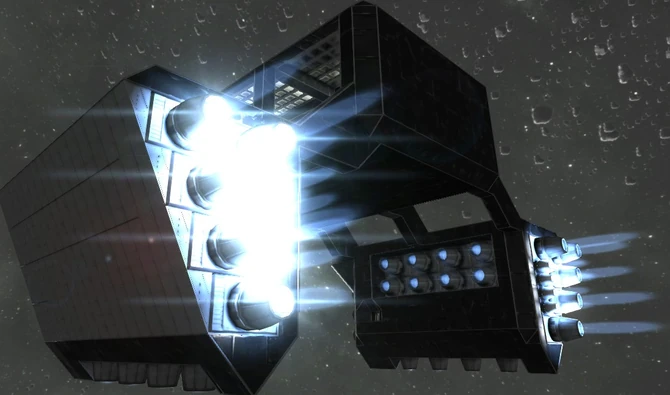
Space Engineers Hangar Update
Added the bullet-proof glass and rearranged the resource dump in the center to make the hangar more streamlined. Next up is steel plating for the hangar doors in the background there.
Thursday, January 1, 2015
List of Needed Changes - Space Engineers
As of 1 January 2015, Space Engineers lacks:
- Microgravity - All objects with mass are pulled towards each other, even if it is by an incredibly small amount. This would make locking landing gear and active inertial dampeners all the more important. This game already sets people's computers on fire because of the amount of calculations required, but I feel this one is important even if it's present in a simplified form.
| http://www.learner.org/courses/physics/unit/text.html?unit=3&secNum=3 |
- Anti-gravity - Either a thruster with power inversely proportional to the amount of gravity in an area, or a field generated (like gravity generators) that cancels out the before-mentioned microgravity or simply cancels out all gravity period. If it's reasonable to assume we can generate gravity then it should be a rational next step to cancel it out. This would also be useful for creating immobile stations in space (assuming there is microgravity).
| http://www.spaceengineerswiki.com/Gravity_HUD |
- Rotational physics - This is a steep request, but currently there is roughly simulated rotational physics with two objects attached to each other, such as a ship and a rotor or piston. Thrusters NOT placed on an axis with the center of mass should pitch, yaw, or roll the craft instead of simply translating it in space.
| http://spaceengineers.wikia.com/wiki/Thruster_mechanics |
- Economy - Resources and items need a generalized monetary value, which could serve as a medium for trades and sales. In single player, economy should have the form of a trade dock, which stores goods for sale or trade. Neutral ships fly in, dock, complete the transaction, and then fly off and despawn. Adventurous players who decide to damage or destroy the trade vessel are charged with either a cool down timer where they must wait a longer period between shipments, or a monetary amount equivalent to the damaged parts of the ship, x time after spawning. In multiplayer, the same dock could be used to carry out passive transactions; players could enter in the good they wish to sell or buy, and then other players could come in and fill those orders. Orders could be transmitted through the antenna. Orders would also persist even if the player is logged off.
| http://i.imgur.com/Cw568hZ.jpg |
| http://i.ytimg.com/vi/g8S9Yb8lAlc/hqdefault.jpg |
- All the resources - I know that in terms of game design, developers generally lean towards simplistic so as to be accessible by a greater audience. I think this logic is flawed because an increase in possible choices doesn't necessarily mean a decrease in accessibility. Choices should be presented organized in a tree-diagram, and in my mind that's how Space Engineers already works: players have to find iron and uranium for basic building materials and fuel to begin a new game, and then move from there. Adding in the rest of the elements, or a majority of them, won't muddy the water, it will simply make the end-game more diverse in possibilities.
| http://www.middlebury.net/op-ed/periodic-table.jpg |
- Convergence of small and large. This one might be impossible from the developers point of view, but theoretically (Let's say I'm the executive producer now) the design choice for making small and large parts and ships and then trying to get them to work together (i.e. conveyors) is more work than is necessary. Parts should be uniform across the board: New Ship, New Station. Done. If the developer really wanted bigger ships, then they should make the uniform parts list scalable in three proportions - small, medium, and large. So if the smallest block is 0.5 meters cubed, the medium would be 1 meter cubed and the large would be 2 meters cubed. Everything fits together nicely.
Tuesday, December 30, 2014
Kerbal Space Program AGP Mod
After spending many hours playing Kerbal Space Program, I decided to make my time spent in space more efficient. My family and I always motivated each other with the ambitions of creating anti-gravity, which, even though none of us are scientists, know is more or less impossible. Luckily, it's easy to make science fiction become science simulation in KSP, and so without further ado, here is my Linear Anti-Gravity Pad.
It fits directly onto a 1x1 panel, has a low profile, and currently uses xenon gas and electricity to produce thrust. In this case, the hex arrays pull the attached objects in the direction it is facing. Eventually I'd like to improve on this design with a particle effect, something like a glow proportional to thrust, as well as a sound effect, such as a low-pitched hum or rumble. Other improvements include a better .mu texture (the current one clamps the texture on the underside corner, which helps orient the model, but looks awful), a gimbal version, and an electricity-only version.
On side notes, I like the B9 Aerospace and KW Rocketry mods, but the multi-model subtypes on many of the parts makes B9 unusable (not to mention what seems like a lot of missing parts), and KW works and is quite appealing, but if I'm going to install a ton of parts, I would like to have spaceplane parts too. I would also recommend Chatterer and the Near Future mods.
I would NOT recommend NEAR or FAR, as they really mess up the game. If you don't like the vanilla physics and think "this game is too easy," by all means knock yourself out. Mostly NEAR just knocks me into unrecoverable rolls in atmo and makes it impossible to land spaceplanes. I didn't try FAR but considering it's supposed to be more advanced, I know the outcome already. I think if the designers wanted simulated realistic physics, they would have already made those changes.
Subscribe to:
Posts (Atom)