Take this quiz: it will tell you if you fit into either a leader or member role.
Friday, March 20, 2015
Are you a leader?
... most likely not. One problem I've run into in my experience is that everyone has a brilliant idea that they want to see become realized, but they have no idea, or the wrong idea, about how to accomplish that goal. If you're going to create a game, especially a big, fancy game, you need a team. That means you have to be a leader, and if you want anything better than garbage for an end product, you have to be a good leader with the ability to effectively communicate, contribute, be personable, and potentially be political. Or, you could simply get some skills, market those skills effectively (by building a great portfolio), get a job with a game development company, and slowly create your game, or game ideas, into undeniably potent productions on the side. Being a leader means taking an awful lot of risk for potentially no or little reward. Being a member means filling a role (who knows, maybe you even enjoy it?!), earning money, and still perhaps following your dreams over a longer time.
Take this quiz: it will tell you if you fit into either a leader or member role.
Take this quiz: it will tell you if you fit into either a leader or member role.

Monday, January 5, 2015
Space Engineers Hangar Update

Added the bullet-proof glass and rearranged the resource dump in the center to make the hangar more streamlined. Next up is steel plating for the hangar doors in the background there.
Thursday, January 1, 2015
List of Needed Changes - Space Engineers
As of 1 January 2015, Space Engineers lacks:

- Microgravity - All objects with mass are pulled towards each other, even if it is by an incredibly small amount. This would make locking landing gear and active inertial dampeners all the more important. This game already sets people's computers on fire because of the amount of calculations required, but I feel this one is important even if it's present in a simplified form.
 |
| http://www.learner.org/courses/physics/unit/text.html?unit=3&secNum=3 |
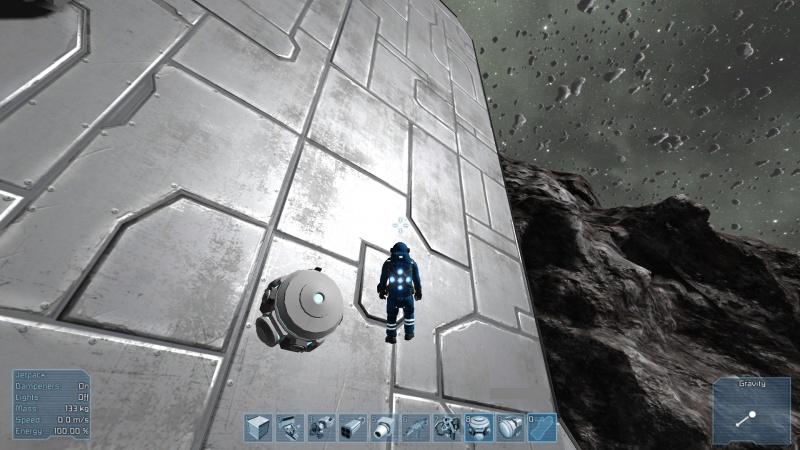
- Anti-gravity - Either a thruster with power inversely proportional to the amount of gravity in an area, or a field generated (like gravity generators) that cancels out the before-mentioned microgravity or simply cancels out all gravity period. If it's reasonable to assume we can generate gravity then it should be a rational next step to cancel it out. This would also be useful for creating immobile stations in space (assuming there is microgravity).
 |
| http://www.spaceengineerswiki.com/Gravity_HUD |
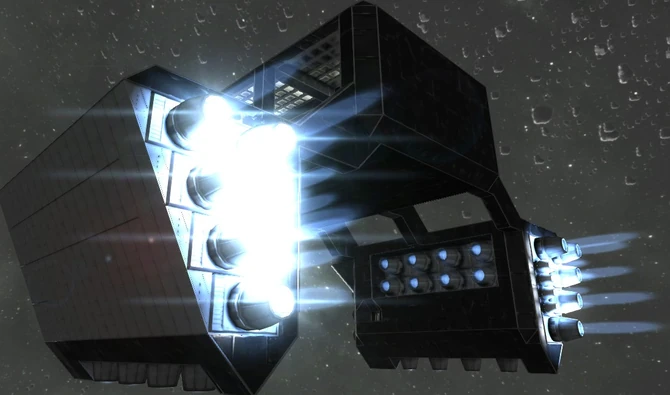
- Rotational physics - This is a steep request, but currently there is roughly simulated rotational physics with two objects attached to each other, such as a ship and a rotor or piston. Thrusters NOT placed on an axis with the center of mass should pitch, yaw, or roll the craft instead of simply translating it in space.
 |
| http://spaceengineers.wikia.com/wiki/Thruster_mechanics |
- Economy - Resources and items need a generalized monetary value, which could serve as a medium for trades and sales. In single player, economy should have the form of a trade dock, which stores goods for sale or trade. Neutral ships fly in, dock, complete the transaction, and then fly off and despawn. Adventurous players who decide to damage or destroy the trade vessel are charged with either a cool down timer where they must wait a longer period between shipments, or a monetary amount equivalent to the damaged parts of the ship, x time after spawning. In multiplayer, the same dock could be used to carry out passive transactions; players could enter in the good they wish to sell or buy, and then other players could come in and fill those orders. Orders could be transmitted through the antenna. Orders would also persist even if the player is logged off.
 |
| http://i.imgur.com/Cw568hZ.jpg |
 |
| http://i.ytimg.com/vi/g8S9Yb8lAlc/hqdefault.jpg |
- All the resources - I know that in terms of game design, developers generally lean towards simplistic so as to be accessible by a greater audience. I think this logic is flawed because an increase in possible choices doesn't necessarily mean a decrease in accessibility. Choices should be presented organized in a tree-diagram, and in my mind that's how Space Engineers already works: players have to find iron and uranium for basic building materials and fuel to begin a new game, and then move from there. Adding in the rest of the elements, or a majority of them, won't muddy the water, it will simply make the end-game more diverse in possibilities.
 |
| http://www.middlebury.net/op-ed/periodic-table.jpg |
- Convergence of small and large. This one might be impossible from the developers point of view, but theoretically (Let's say I'm the executive producer now) the design choice for making small and large parts and ships and then trying to get them to work together (i.e. conveyors) is more work than is necessary. Parts should be uniform across the board: New Ship, New Station. Done. If the developer really wanted bigger ships, then they should make the uniform parts list scalable in three proportions - small, medium, and large. So if the smallest block is 0.5 meters cubed, the medium would be 1 meter cubed and the large would be 2 meters cubed. Everything fits together nicely.
Subscribe to:
Posts (Atom)